

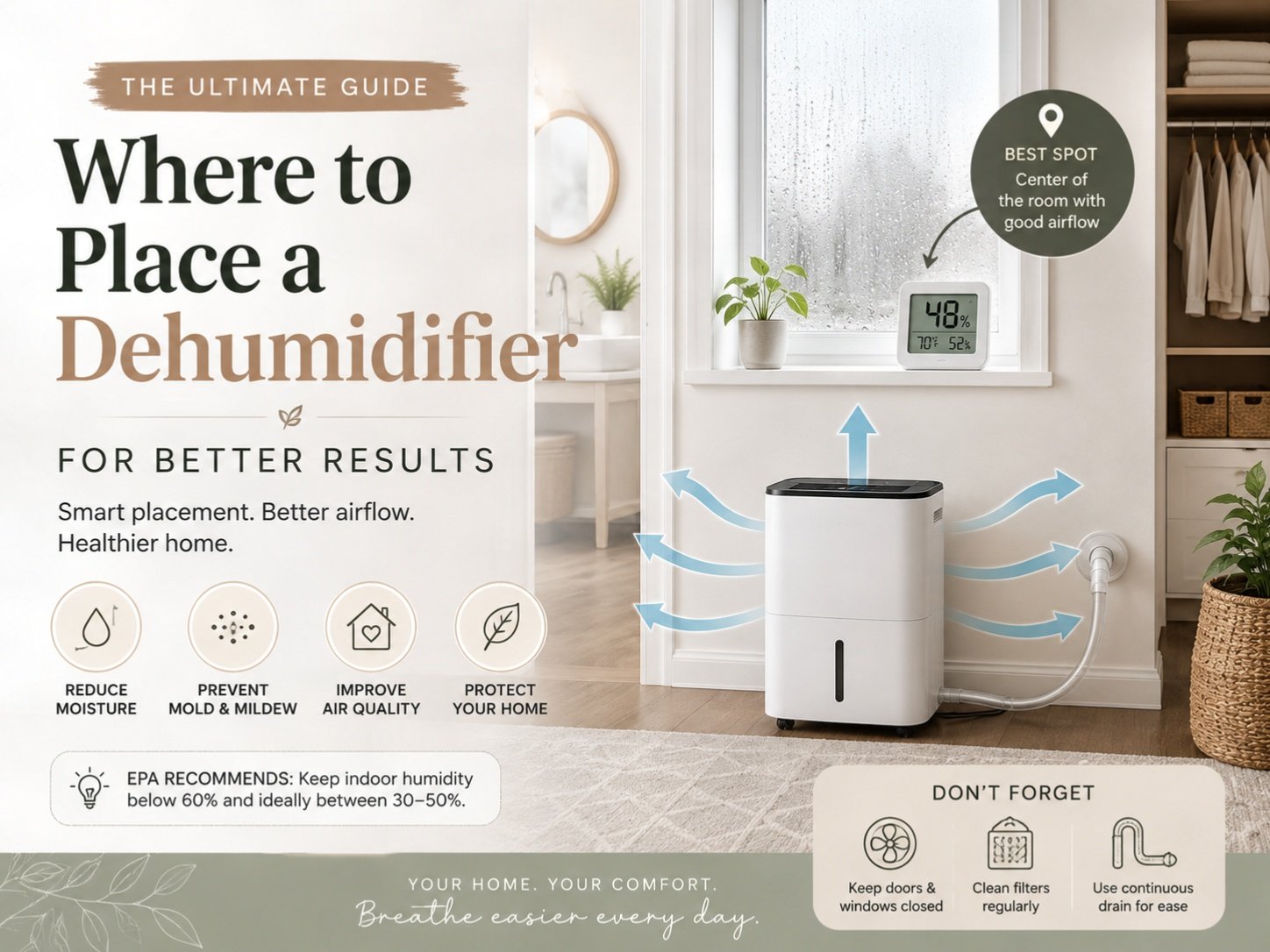
Knowing where to place a dehumidifier can make the difference between a machine that quietly helps your home feel drier and one that runs for hours without much visible change. If the air still feels damp, the room smells musty, or condensation keeps showing up, the problem may not be the dehumidifier itself. It may be the placement.
I recommend thinking about airflow first. A dehumidifier needs room to pull in damp air and release drier air back into the space. If it is pushed into a corner, blocked by furniture, placed too far from the damp area, or set up in a room with open windows, it may not reduce humidity as well as it should.
In this GloMiaFinds guide, I’ll explain where to place a dehumidifier for better results, where not to put it, how to use a humidity monitor, when a drain hose helps, and what to check if the room still feels damp.
This article is for general home organization and moisture-control information only. If you have visible mold, repeated leaks, flooding, structural moisture, electrical concerns, or a dampness problem that keeps returning, I recommend contacting a qualified home, HVAC, plumbing, electrical, or mold professional.
Why Dehumidifier Placement Matters
A dehumidifier works by pulling moisture from the air. That means it needs access to the air you actually want to dry. If the unit is hidden behind a couch, tucked inside a tight corner, blocked by curtains, or placed where air cannot circulate, it may run without noticeably improving the room.
The EPA explains in its brief guide to mold, moisture, and your home that indoor humidity should be kept below 60 percent if possible, and ideally between 30 and 50 percent. ENERGY STAR also says the optimum relative humidity level for a building is generally considered to be 30 to 50 percent, and levels above that range may promote mold growth in some conditions.
That does not mean a dehumidifier fixes every moisture problem. The EPA also notes that moisture control is the key to mold control, and if you clean up mold but do not fix the water problem, the mold problem will likely come back.
GloMiaFinds tip:
A dehumidifier can help manage damp air, but it cannot replace fixing leaks, drainage problems, poor ventilation, or water intrusion.
Where to Place a Dehumidifier for Better Results
1. Place It Near the Center of the Damp Area
The best place to start is near the center of the room or damp zone. GE Appliances recommends placing a dehumidifier near the center of the area you want to dehumidify for best results.
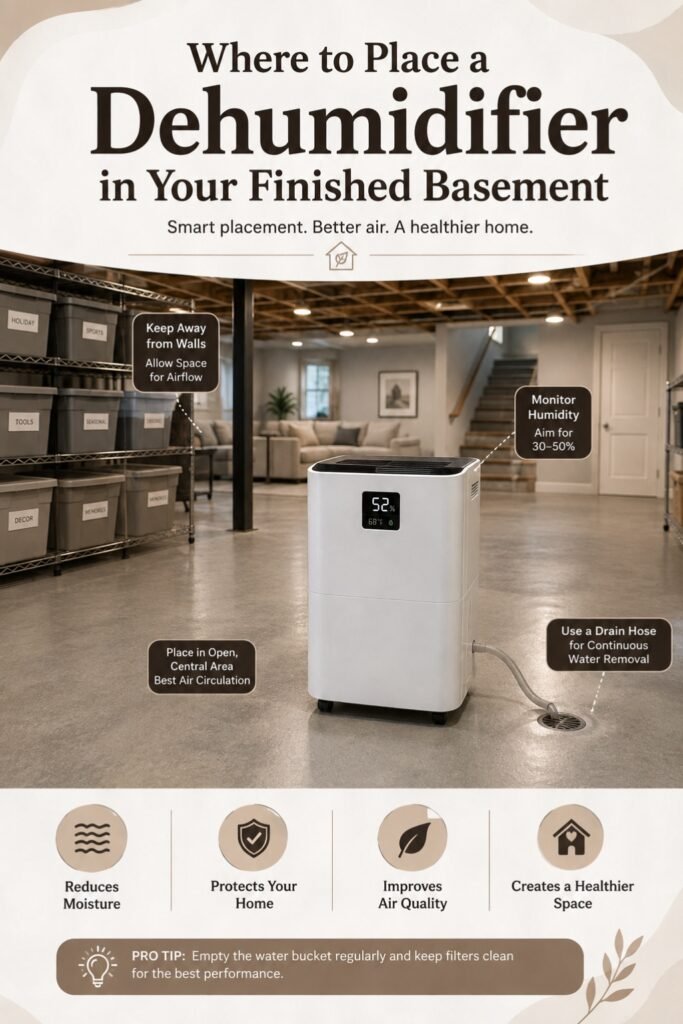
This does not mean it has to sit perfectly in the middle of the room forever. It simply means the unit needs access to the air around it. A central location helps it pull damp air from more of the space instead of only drying the small corner where it sits.
Good central locations include:
- Middle of a basement room
- Open area of a laundry room
- Center of a large bathroom after shower moisture clears
- Open hallway near damp bedrooms
- Clear spot in a finished lower-level room
- Central area of a storage room
GloMiaFinds tip:
If the room is large, start central for a few days, then check humidity readings in different corners to see if one area still stays damp.
2. Keep Space Around the Unit
A dehumidifier needs airflow around it. GE Appliances recommends allowing at least 18 inches of air space on all sides for good circulation. It also warns that curtains, blinds, or furniture blocking the front or back can stop a dehumidifier from reaching the proper humidity level.
This is one of the most common placement mistakes I see in home setups. The unit is technically running, but it is boxed in by a wall, storage bin, laundry basket, couch, or curtain.
Keep it away from:
- Walls
- Curtains
- Furniture
- Storage bins
- Laundry piles
- Closet doors
- Large rugs that bunch around it
- Anything that blocks the intake or exhaust
GloMiaFinds tip:
If the air feels damp but the bucket barely fills, check whether the intake or front grille is blocked before assuming the unit is broken.
3. Put It in the Dampest Room First
If one room has the strongest musty smell, visible condensation, damp flooring, or a consistently higher humidity reading, start there. A dehumidifier works best when it is placed where the moisture problem is strongest.
Common damp areas include:
- Basements
- Laundry rooms
- Bathrooms
- Crawl-space entrances
- Utility rooms
- Rooms with poor airflow
- Rooms with exterior walls
- Rooms where condensation appears on windows
- Storage rooms with musty odors
The EPA says condensation on windows, walls, or pipes can be a sign of high humidity and recommends drying wet surfaces quickly while reducing the moisture source.
GloMiaFinds tip:
If the whole home feels damp, do not guess. Use a humidity monitor in several rooms so you know where the problem is strongest.
4. Use a Humidity Monitor Away From the Air Outlet
A humidity monitor helps you see whether the dehumidifier is actually improving the room. ENERGY STAR recommends using a hygrometer if your dehumidifier does not have a built-in humidistat or if the built-in humidistat does not show relative humidity levels.
Place the humidity monitor near the dehumidifier, but not directly in the stream of warm, dry air coming out of the machine. If the monitor sits too close to the outlet, it may show a lower humidity number than the rest of the room.
Better humidity monitor spots include:
- Across the room from the unit
- On a shelf at breathing height
- Near the damp area, but not on a wet surface
- Away from vents, heaters, windows, and direct sunlight
- In a second room if you are testing whole-area performance
GloMiaFinds tip:
Check the humidity before turning the unit on, then again after several hours. One reading is helpful, but a pattern is better.
5. Keep Windows and Exterior Doors Closed While It Runs
If windows or outside doors are open, the dehumidifier may keep pulling in fresh humid air from outdoors. That can make it run longer without reaching the target humidity.
GE Appliances says good air circulation within an enclosed area is essential and that doors and windows should be kept closed. GE also lists open windows and doors as one reason a dehumidifier may not reach the proper humidity level.
For better results:
- Close windows.
- Close exterior doors.
- Avoid running it during open-window airing-out time.
- Use exhaust fans during moisture-heavy tasks.
- Let the dehumidifier work in an enclosed area.
GloMiaFinds tip:
Ventilation and dehumidifying are both useful, but they work best at different times. Air out a room when outdoor air is dry, then close the space when the dehumidifier is running.
6. Do Not Put It Directly Against a Moisture Source
It may seem logical to place a dehumidifier right under a damp window or beside a wet wall, but that is not always the best setup. If the unit is too close to the wall, airflow may be restricted. If it is too close to water, electrical safety becomes a concern.
ENERGY STAR warns to follow manufacturer electrical safety instructions and never set up water drainage or disposal near electrical circuits or devices. It also says drain hoses should be kept away from electrical cords and connections.
A better approach is to place the unit in the same damp room, but with enough open space for airflow and safe drainage.
GloMiaFinds tip:
Place the dehumidifier near the damp zone, not pressed into it. Airflow and safety matter more than being directly under the wet spot.
7. Use a Drain Hose Only When the Location Supports It
A drain hose can make a dehumidifier easier to use, especially in a basement, utility room, or laundry room where the bucket fills quickly. But the placement needs to make sense.
ENERGY STAR recommends locating the unit close enough to a floor drain or sump if you plan to use a hose, so you do not create a long, awkward hose run or a tripping hazard.
A drain hose works best when:
- The unit is near a floor drain
- The hose can slope properly
- The hose is not kinked
- The hose is not routed across a walking path
- The connection washer is in good condition
- The hose stays away from electrical cords and outlets
Frigidaire notes that a dehumidifier can leak if it is not on a flat, level floor. It also says drain hose connectors can leak if washers are missing, worn out, or cracked.
GloMiaFinds tip:
If your drain hose setup is awkward, use the bucket until you can place the unit closer to a safe drain point.
8. Keep It on a Flat, Level Surface
A dehumidifier should sit on a stable, level surface. This helps the bucket seat correctly, supports drainage, and reduces the chance of water leaking.
Frigidaire recommends making sure the unit is on a flat and level floor if there is leaking around the bucket.
Avoid placing it on:
- Uneven flooring
- Thick rugs
- Sloped basement areas
- Wobbly stands
- Wet flooring
- Soft surfaces that block airflow
- Surfaces where it may tip
GloMiaFinds tip:
If the bucket keeps filling unevenly or the unit leaks, check the floor level before changing the settings.
9. Choose the Right Spot in a Basement
Basements are one of the most common places for dehumidifiers because they often have cooler surfaces, limited airflow, and more moisture exposure.
For a basement, place the unit:
- In the main open area
- Away from walls and storage stacks
- Near a drain if using continuous drainage
- Away from electrical panels and cords
- Where air can circulate around the room
- Near the dampest zone if one side is worse
ENERGY STAR also recommends reducing moisture at the source by improving drainage around the foundation, keeping gutters and downspouts clear, extending downspouts away from the foundation, and making sure soil slopes away from the home.
GloMiaFinds tip:
If your basement humidity keeps climbing back up, placement may help, but exterior drainage may also need attention.
10. Use a Compact Dehumidifier Only in Small, Specific Areas
A compact dehumidifier can be helpful for a small bathroom, closet, laundry corner, pantry-like storage area, or tiny bedroom, but it should match the size and dampness of the space. A small unit may not noticeably improve a large basement or open floor plan.
For better results, use a compact unit in:
- Small bathrooms
- Closets
- Laundry nooks
- Small bedrooms
- Storage corners
- RV-style spaces
- Small enclosed rooms
If the space is large, very damp, or connected to other open rooms, you may need a larger properly sized model or a different moisture-control solution.
GloMiaFinds tip:
If a compact unit runs constantly and the humidity barely changes, the space may be too large or too damp for that size.
11. Be Careful With Smart Plugs
A smart plug can seem convenient if you want a dehumidifier to run on a schedule. I would be cautious here because a dehumidifier is an appliance with a motor and moisture nearby.
The U.S. Fire Administration recommends plugging major appliances directly into a wall outlet and not overloading outlets. It also warns against using extension cords with major appliances because they can overheat and start a fire.
If you use a smart plug, only use one if your dehumidifier manual allows it, the smart plug is properly rated for the appliance load, the plug is listed by a recognized safety testing organization, and the setup does not interfere with the dehumidifier’s built-in safety features.
Avoid:
- Extension cords
- Power strips
- Loose outlets
- Overloaded outlets
- Wet areas near the plug
- Smart plugs that are not rated for the appliance
- Turning the unit on and off too frequently
GloMiaFinds tip:
When in doubt, use the dehumidifier’s built-in humidistat or timer instead of adding a smart plug.
Best Places to Put a Dehumidifier by Room
Basement
Place it in the main open area, away from walls, boxes, and furniture. If using continuous drainage, place it near a safe floor drain or sump.
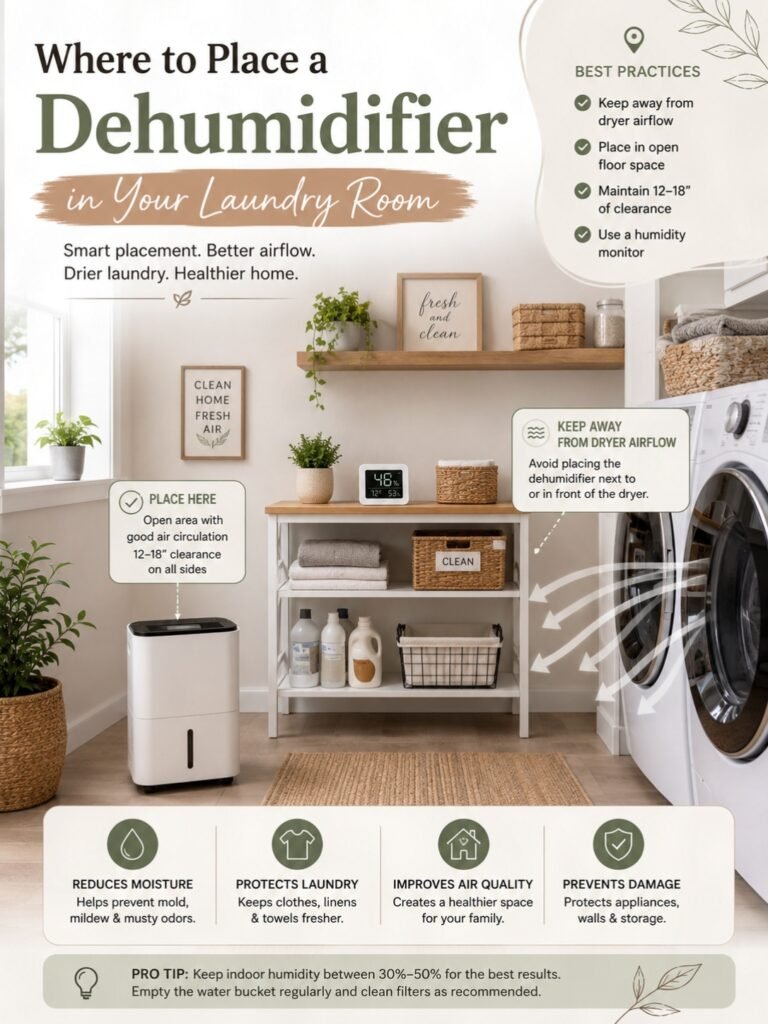
Laundry Room
Place it away from the dryer’s hot, moisture-heavy air stream. GE Appliances notes that running a dryer in the same room can affect a dehumidifier’s ability to dry the space.
Bathroom
Place it outside the splash zone, away from tubs, showers, sinks, and wet floors. Use exhaust fans during and after showers when possible.
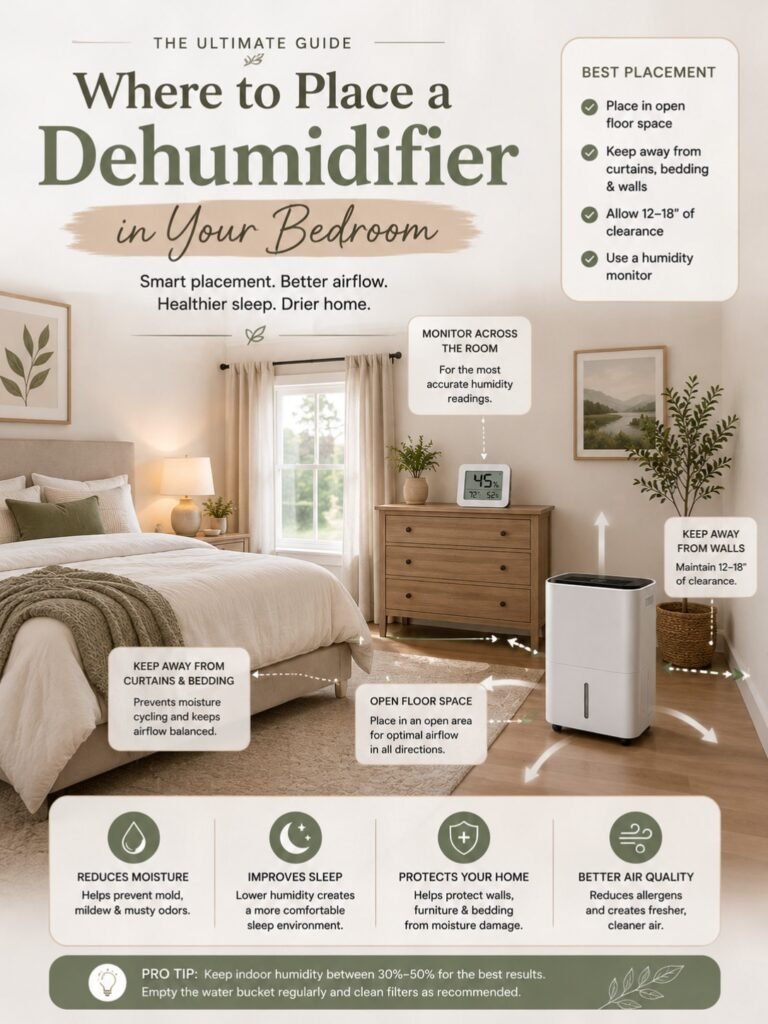
Bedroom
Place it where air can circulate, not directly beside bedding, curtains, or furniture. Use a humidity monitor across the room to check whether the entire bedroom improves.
Closet
Use only a compact unit that fits safely with airflow around it. Do not wedge a dehumidifier into a crowded closet full of fabric, boxes, or shoes.
Kitchen
Use exhaust fans while cooking or dishwashing. If a kitchen stays humid, place the dehumidifier in an open area away from sinks, stoves, and cords.
Storage Room
Place it where damp air can reach the unit, not behind stacked bins. Leave space around stored items so air can move.
Hallway
A hallway can work if several nearby rooms feel damp, but doors need to stay open so air can circulate. Use humidity monitors in the rooms to see if the setup is helping.
Why Your Dehumidifier Is Running but the Room Still Feels Damp
The Unit Is Blocked
Furniture, curtains, storage bins, or walls may be blocking airflow.
The Windows Are Open
Open windows can keep bringing humid outdoor air into the room.
The Room Is Too Large
A compact unit may not be strong enough for a large or very damp space.
The Filter Is Dirty
Frigidaire notes that a blocked front grille can stop a unit from working properly, and GE Appliances says a clogged filter can restrict airflow.
The Bucket Is Full
If the bucket is full, many units pause until it is emptied.
The Unit Needs More Time
Frigidaire says a unit may need 24 hours to properly lower humidity in a room. GE Appliances notes that a new installation may need three to four days to remove moisture from the air, walls, and objects in the room.
The Moisture Source Has Not Been Fixed
Leaks, poor drainage, wet materials, damp walls, or indoor drying can keep adding moisture faster than the unit can remove it.
The Temperature Is Too Low
GE Appliances says dehumidifiers may not operate satisfactorily below 41 degrees Fahrenheit unless the model is designed for low-temperature operation.
Common Dehumidifier Placement Mistakes to Avoid
Pushing It Against a Wall
This blocks airflow and makes the unit work harder.
Hiding It Behind Furniture
A hidden dehumidifier may look neater, but it will not work well if it cannot pull in room air.
Placing It Too Far From the Damp Area
If the moisture problem is in the basement and the unit is upstairs, it may not help much.
Leaving Windows Open
The unit may keep fighting outdoor humidity.
Using a Long Drain Hose Across the Room
A long hose can become a tripping hazard and may not drain well.
Placing It Near Electrical Panels
Keep water collection and drainage away from electrical circuits, cords, and devices.
Ignoring Humidity Readings
Guessing can lead to running the unit too much or not enough.
Using the Wrong Size Unit
A compact unit is not meant to handle a large wet basement.
Forgetting the Moisture Source
A dehumidifier helps manage humidity, but leaks and drainage problems still need to be fixed.
Quick Dehumidifier Placement Checklist
Use this checklist when deciding where to place a dehumidifier.
- Put it near the center of the damp area.
- Leave open space around the unit.
- Keep windows and exterior doors closed while it runs.
- Place it on a flat, level surface.
- Keep it away from curtains, furniture, and storage bins.
- Keep drainage away from electrical cords and outlets.
- Use a humidity monitor to track results.
- Place the monitor away from direct dry air.
- Use a drain hose only if the route is safe and short.
- Avoid extension cords and overloaded outlets.
- Clean the filter as directed by the manual.
- Give the unit enough time to reduce moisture.
- Fix leaks, drainage issues, and ventilation problems.
FAQ
Where is the best place to put a dehumidifier?
The best place to put a dehumidifier is near the center of the damp area with open space around it for airflow. It should sit on a flat, level surface and should not be blocked by furniture, curtains, walls, or storage bins.
Should a dehumidifier be placed high or low?
Most portable dehumidifiers are designed to sit on the floor. Always follow your model’s manual. The most important thing is keeping the unit level, stable, and clear of airflow blockages.
Should doors be open or closed when using a dehumidifier?
Exterior doors and windows should be closed while the dehumidifier runs. Interior doors can stay open if you are trying to dry nearby connected spaces, but the unit will work best when air can circulate freely.
Can I put a dehumidifier in a corner?
A corner is usually not the best place unless the unit still has the clearance required by the manual. A dehumidifier needs open airflow around the intake and exhaust.
Can I put a dehumidifier near a wall?
Avoid pushing it directly against a wall. GE Appliances recommends at least 18 inches of air space on all sides for good circulation.
Can one dehumidifier work for multiple rooms?
It can help connected rooms if doors stay open and air circulates, but it may not work well for separated rooms or closed doors. Use humidity monitors in different rooms to see whether it is actually helping.
Why is my dehumidifier running but not lowering humidity?
It may be blocked, undersized, placed poorly, running with windows open, clogged, full, or working against a moisture source that has not been fixed. It may also need more time if the walls, furniture, or stored items are damp.
Should I use a humidity monitor with a dehumidifier?
Yes. A humidity monitor helps you see whether the room is actually improving. ENERGY STAR recommends using a separate hygrometer if your dehumidifier does not show relative humidity levels.
Is a drain hose worth using?
A drain hose can be helpful if the unit fills quickly and can drain safely into a nearby floor drain or sump. Keep the hose short, sloped correctly, away from walkways, and away from electrical cords.
Can I plug a dehumidifier into a smart plug?
Only use a smart plug if your dehumidifier manual allows it and the smart plug is properly rated for the appliance. Avoid extension cords, overloaded outlets, wet plug areas, and setups that bypass built-in safety features.
Conclusion
Knowing where to place a dehumidifier helps the unit work more effectively and makes it easier to tell whether it is actually reducing dampness. Start with the dampest area, keep the unit central, leave space around it, close windows while it runs, use a humidity monitor, and keep drainage safe.
I recommend checking the room after several hours and again over a few days. If the humidity drops, the placement is probably working. If the room still smells musty or the number stays high, look for blocked airflow, open windows, a full bucket, a dirty filter, poor drainage, or a moisture source that needs repair.
A dehumidifier works best when it is part of a bigger moisture-control plan. Good placement helps, but the real goal is a drier, safer, easier-to-maintain home.
Sources
- EPA: A Brief Guide to Mold, Moisture and Your Home
- EPA: Ten Things You Should Know About Mold
- ENERGY STAR: Dehumidifiers
- GE Appliances: Dehumidifier Ideal Operating Conditions
- GE Appliances: Dehumidifier Not Reaching Proper Humidity Level
- Frigidaire: Dehumidifier Room Is Not Dry Enough
- Frigidaire: Dehumidifier Water Leaking Issues
- U.S. Fire Administration: Appliance and Electrical Fire Safety
- U.S. Fire Administration: Plug Major Appliances Into a Wall Outlet