

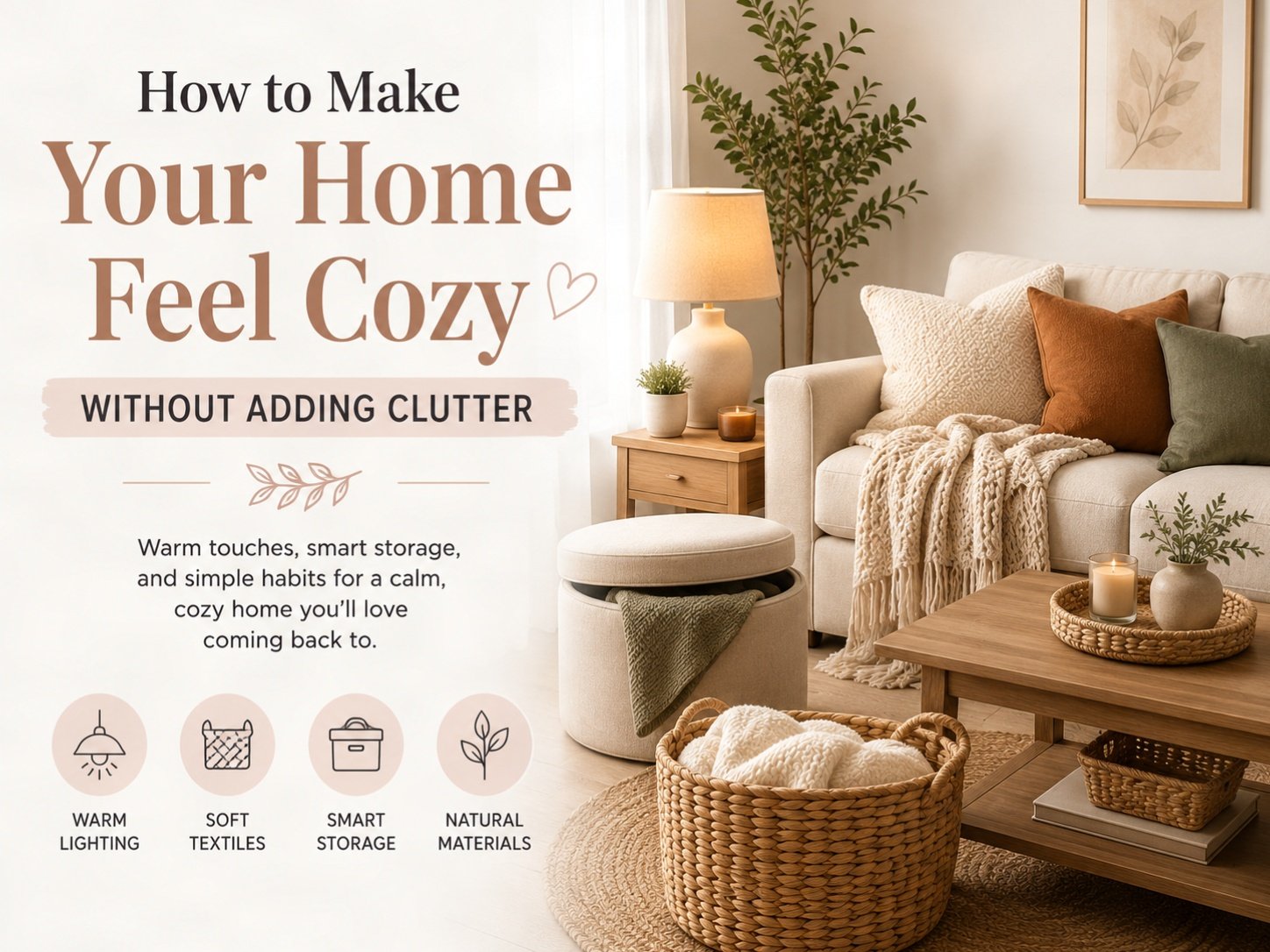
How to make your home feel cozy without adding clutter starts with choosing warmth, softness, and function instead of filling every empty space. I recommend focusing on lighting, texture, natural materials, and practical storage so your home feels welcoming without becoming visually overwhelming.
A cozy home does not need piles of pillows, crowded shelves, or seasonal decor on every surface. In my experience, the most comfortable rooms usually have fewer pieces, better placement, warmer light, and items that are both beautiful and useful.
In this GloMiaFinds guide, I’ll share how to make your home feel cozy without adding clutter using warm lighting, layered textiles, natural materials, practical storage, and simple room-by-room choices that make your space feel calm instead of crowded.
This article is for general home styling and organization guidance only. Always follow manufacturer instructions for lighting, candles, storage furniture, and electrical items. If a light fixture, outlet, cord, or candle setup feels unsafe, stop using it and check with a qualified professional.
Why Cozy Does Not Have to Mean More Stuff
The biggest mistake people make when learning how to make your home feel cozy without adding clutter is assuming cozy means adding more decor. More pillows, more baskets, more candles, more trays, and more wall art can actually make a room feel busy instead of peaceful.
Cozy comes from how a room feels. That feeling can come from:
- Soft lighting
- Warm colors
- Comfortable seating
- Natural textures
- Clear surfaces
- Useful storage
- Fewer visual distractions
- A room layout that feels easy to live in
The University of Georgia Extension notes that a clean home can mean less exposure to contaminants, less clutter, and a more comfortable living environment. UGA Extension’s healthy housing guidance is a helpful reminder that comfort and clutter control can work together.
I think that is the key. A cozy home should feel lived-in, but not overloaded. You want warmth without mess, layers without piles, and storage that helps the room breathe.
How to Make Your Home Feel Cozy Without Adding Clutter
1. Start With Warm Lighting Instead of More Decor
The fastest way to understand how to make your home feel cozy without adding clutter is to look at your lighting first. Cool, harsh overhead lighting can make even a beautifully decorated room feel flat. Warm, lower lighting makes a space feel softer almost immediately.
The U.S. Department of Energy explains that artificial light color can range from warm yellowish white to cool bluish white, and this color appearance is measured as correlated color temperature in Kelvin. DOE’s light bulb guidance explains how color temperature works.
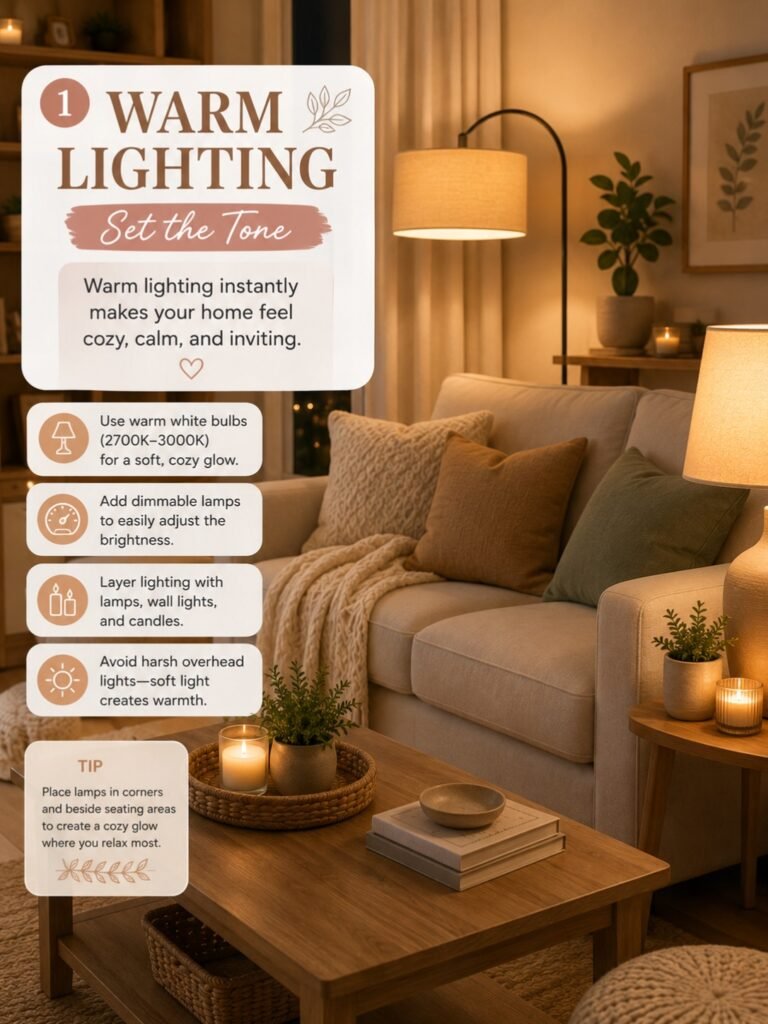
For a cozy look, I usually prefer warm white or soft white bulbs. ENERGY STAR guidance explains that warm inviting light is typically labeled warm white or soft white and often sits around 2700K to 3000K. ENERGY STAR lighting guidance is useful when choosing bulbs.
One light product I would consider for this topic is a set of warm dimmable LED bulbs. They are practical because they change the mood of a room without adding objects to your shelves or counters.
Best for: living rooms, bedrooms, dining rooms, entryways, reading corners.
What to try:
- Warm white LED bulbs
- Dimmable bulbs if your fixture supports them
- Table lamps instead of only overhead light
- Floor lamps beside seating
- Small accent lights on existing furniture
GloMiaFinds tip:
Before you buy more decor, change one harsh bulb to a warmer one. It can make the room feel softer without adding a single extra object.
2. Use Layers of Light, Not Layers of Stuff
A good cozy room usually has more than one light source. That does not mean you need many lamps. It means each light should have a purpose.
For example, a living room can feel much warmer with:
- One floor lamp near the sofa
- One small table lamp on an existing side table
- One warm bulb in a ceiling fixture
- One picture light or shelf light if you already have that setup
ENERGY STAR notes that to save energy, you can choose the bulb brightness you need in lumens, then select the option with the lowest wattage. ENERGY STAR’s brightness guide is useful if you are comparing LED bulbs.
This is one of my favorite ways to show how to make your home feel cozy without adding clutter because lighting changes the feeling of the room without adding visual mess.
Best for: small apartments, minimal homes, open living spaces, dark corners.
What to avoid:
- Too many small novelty lamps
- Harsh white bulbs in relaxing spaces
- Lamps with cords crossing walkways
- Adding a new lamp when changing the bulb would fix the issue
GloMiaFinds tip:
If a room feels cold, try warm bulbs and lower lamp placement before buying more pillows, signs, or decorative objects.
3. Add One Soft Textile Per Area
Textiles make a home feel cozy, but they can also create clutter fast. The trick is to add one useful soft layer per zone.
When thinking about how to make your home feel cozy without adding clutter, I like asking: “Will this textile be used, or will it just sit there?”
Good examples include:
- One throw blanket on the sofa
- One washable rug in the entry
- One soft runner beside the bed
- One pair of curtains that soften the room
- One textured pillow on a chair
- One folded quilt at the end of the bed
A single warm textile can do more than five random decorative pieces.
Best for: living rooms, bedrooms, reading corners, guest spaces.
What to try:
- Cotton throw
- Linen curtains
- Wool-look rug
- Soft cushion cover
- Quilted bed layer
- Textured table runner
GloMiaFinds tip:
If you already have pillows, do not keep adding more. Swap the cover for a warmer texture instead.
4. Choose Textures That Work Hard
Texture is one of the best tools for how to make your home feel cozy without adding clutter because it adds warmth without needing many items.
Instead of adding five decorations to a coffee table, you can make the room feel warmer with one textured rug, one woven basket, or one linen curtain panel.
Textures that feel cozy include:
- Boucle
- Cotton
- Linen
- Jute
- Rattan
- Wool
- Woven seagrass
- Soft knits
- Washed wood
- Matte ceramics
The Smithsonian advises that textiles need some air movement when stored and should not be sealed in airtight plastic because trapped moisture can damage fibers. Smithsonian textile storage guidance is useful if you rotate throws, quilts, or seasonal cushion covers.
Best for: neutral rooms, minimal rooms, rentals, small spaces.
GloMiaFinds tip:
Texture lets you keep the color palette simple while still making the room feel warm and finished.
5. Bring in Natural Materials
Natural materials help a room feel grounded. Wood, stone, linen, cotton, clay, rattan, bamboo, jute, and seagrass can make a space feel warmer without looking overdecorated.
This is a simple part of how to make your home feel cozy without adding clutter because natural materials often look good even when you use fewer pieces.
Try adding natural materials through items you already need:
- Wood picture frames
- Woven storage baskets
- Linen curtains
- Jute rug
- Wooden tray
- Ceramic lamp
- Rattan chair
- Stone coaster
- Cotton throw
One practical affiliate product I would consider here is lidded woven storage baskets. They add texture, hide everyday items, and keep surfaces clearer.
Best for: blankets, toys, cords, pet items, seasonal decor, entryway accessories.
GloMiaFinds tip:
Natural materials work best when they are also useful. A basket that hides clutter is better than a decorative basket that just becomes clutter.

6. Keep Surfaces Mostly Clear
If you want to know how to make your home feel cozy without adding clutter, pay attention to flat surfaces. Coffee tables, nightstands, entry tables, kitchen counters, and dressers collect visual noise quickly.
A cozy surface does not have to be empty. It just needs breathing room.
Try this simple formula:
- One useful item
- One warm item
- One personal item
For example:
- A lamp
- A small tray
- One framed photo
Or:
- A candle warmer or lamp
- A small book stack
- A ceramic bowl for keys
The point is to stop before the surface looks crowded.
Best for: coffee tables, nightstands, entry tables, kitchen islands, bathroom counters.
GloMiaFinds tip:
If every surface has decor, the room has nowhere for the eye to rest.
7. Use Storage That Looks Like Decor
Practical storage is one of the strongest parts of how to make your home feel cozy without adding clutter. The goal is not to hide your life. The goal is to give everyday items a place to land.
Good cozy storage should be easy to use. If storage is too complicated, items will still end up on the chair, counter, or floor.
A second practical product I would consider is a storage ottoman. It can work as seating, a footrest, a coffee table alternative, and hidden storage for blankets, games, toys, or remote controls.
Best for: small living rooms, apartments, family rooms, bedrooms, play areas.
What to look for:
- Soft upholstery
- Hinged or lift-off lid
- Enough interior space
- Neutral color
- Easy-to-clean fabric
- Stable top if using with a tray
GloMiaFinds tip:
The best storage is the kind you can use in five seconds. If it is hard to open, move, or reach, it will not solve clutter.
8. Create Cozy Zones Instead of Decorating Every Corner
A cozy home does not need every corner styled. Instead, focus on a few small zones where comfort matters most.
This is one of the easiest ways to practice how to make your home feel cozy without adding clutter because you stop trying to decorate the whole house at once.
Try creating:
- A reading corner
- A cozy sofa zone
- A soft bedside area
- A warm entryway drop zone
- A calm dining corner
- A tidy coffee station
- A blanket basket near the couch
Each zone should have a purpose. If it does not support how you live, it may just become another clutter spot.
GloMiaFinds tip:
One cozy corner can change the mood of a room more than scattered decor everywhere.
9. Use Scent Carefully and Safely
Scent can make a home feel cozy, but it should not add clutter or create safety problems. One candle, one diffuser, or one simmer pot is usually enough.
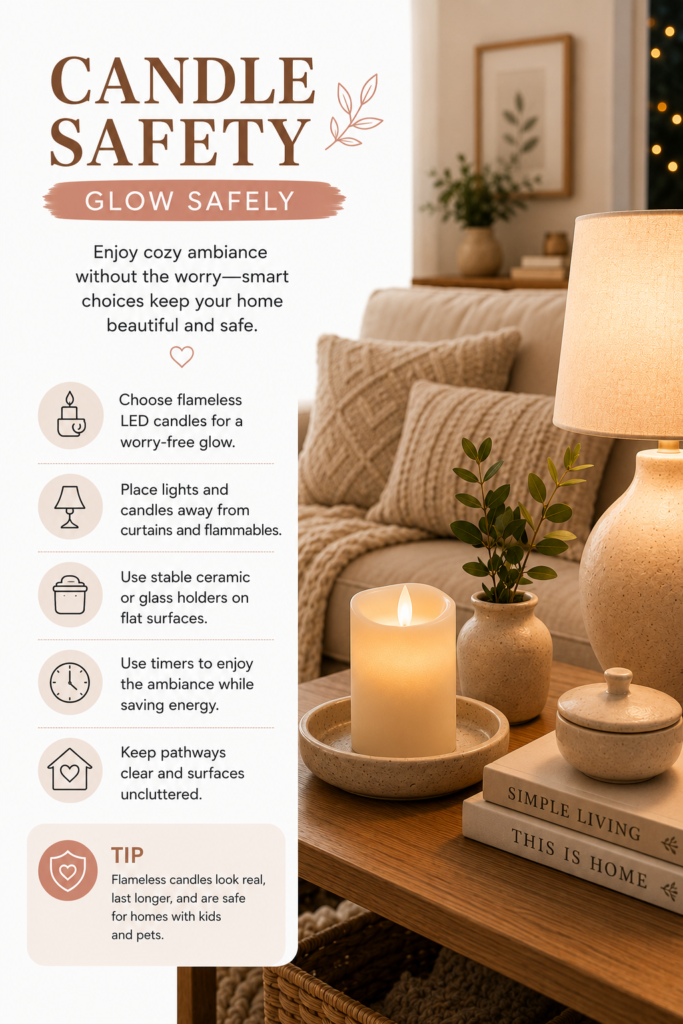
If you use candles, follow fire safety guidance. The U.S. Fire Administration recommends blowing out candles when you leave a room, leave home, or go to bed. USFA candle safety guidance is important if candles are part of your cozy routine.
Best for: evening routines, bathrooms, living rooms, guest areas.
What to try:
- One candle in a safe holder
- Flameless candle
- Essential oil diffuser used as directed
- Simmer pot while supervised
- Fresh air before adding fragrance
GloMiaFinds tip:
If you have pets, children, asthma, migraines, or scent sensitivities at home, choose fragrance carefully and keep safety first.
10. Follow a One-In, One-Out Cozy Rule
The final step in how to make your home feel cozy without adding clutter is keeping new items from piling up. Cozy homes can slowly become cluttered when every seasonal candle, pillow, throw, tray, and basket stays forever.
Use a simple rule: when one new cozy item comes in, one old item leaves, gets donated, or gets stored properly.
This works especially well for:
- Throw pillows
- Blankets
- Seasonal decor
- Candles
- Baskets
- Mugs
- Wall art
- Decorative trays
Professional organizing sources often emphasize that clutter affects how comfortable a home feels. NAPO explains that professional organizers help with organizing and decluttering areas like kitchens, closets, living rooms, bedrooms, home offices, and storage spaces. NAPO’s professional organizing overview shows how common household clutter management is.
GloMiaFinds tip:
A cozy item still needs a home. If you do not know where it will live, pause before buying it.
Room-by-Room Cozy Ideas Without Clutter
Living Room
For the living room, focus on lighting and one strong textile layer.
Try:
- Warm bulbs in lamps
- One soft throw
- One lidded basket for blankets
- Clear coffee table
- Storage ottoman if you need hidden storage
- One natural texture, like wood or jute
This is the room where how to make your home feel cozy without adding clutter matters most because the living room often gets the most daily use.
Bedroom
For the bedroom, choose calm over crowded.
Try:
- Warm bedside lighting
- Soft sheets
- One quilt or throw
- Clear nightstand
- Under-bed storage if needed
- Curtains that soften the room
Avoid turning the bed into a mountain of pillows you remove every night.
Entryway
For the entryway, cozy should also be practical.
Try:
- Small warm lamp if there is a table
- Basket for scarves or gloves
- Hooks for daily bags
- Shoe tray
- Natural fiber rug
- Small bowl for keys
A cozy entryway should welcome you home without becoming a drop zone for everything.
Kitchen
For the kitchen, cozy comes from warmth and order.
Try:
- Clear counters
- Wood cutting board displayed intentionally
- Small lamp if safe and practical
- Linen towel
- Basket for fruit
- One warm rug runner if it does not create a tripping hazard
Do not cover the counters with decor if you need the prep space.
Bathroom
For the bathroom, cozy should feel clean and simple.
Try:
- Soft hand towels
- Warm light
- One small tray
- Closed storage for extras
- A washable bath mat
- One plant if the room has suitable light
A bathroom feels cozier when it looks fresh, not packed.
Common Mistakes to Avoid
Buying More Decor Before Fixing Lighting
Lighting sets the mood. If your bulbs are harsh, more decor will not fix the room.
Adding Too Many Pillows
Pillows are cozy until they take over the sofa or bed.
Using Baskets Without Decluttering First
Baskets can hide clutter, but they should not become clutter bins with no purpose.
Decorating Every Surface
A cozy room needs empty space too.
Choosing Pretty Storage That Is Hard to Use
If storage is inconvenient, everyday items will still end up out in the open.
Keeping Every Seasonal Item
Seasonal decor can add warmth, but too much makes a home feel busy.
Forgetting Safety With Candles and Cords
Cozy lighting should still be safe lighting. Watch candles, avoid overloaded outlets, and keep cords clear of walkways.
Quick Cozy Reset Checklist
Use this simple checklist when you want how to make your home feel cozy without adding clutter to feel easier.
- Swap harsh bulbs for warm bulbs.
- Add one soft textile per main area.
- Use natural materials where possible.
- Clear flat surfaces.
- Hide daily items in easy storage.
- Create one cozy zone per room.
- Keep cords tidy.
- Use candles safely.
- Remove one item when you add one item.
- Choose comfort over decoration.
FAQ
How do I make my home cozy without adding clutter?
The best way to learn how to make your home feel cozy without adding clutter is to focus on warm lighting, soft textiles, natural materials, clear surfaces, and practical storage. Change the mood before adding more objects.
What makes a home feel cozy?
A home feels cozy when it has warm lighting, comfortable seating, soft textures, natural materials, personal touches, clean surfaces, and a layout that feels easy to live in.
How can I make a small home cozy without making it feel crowded?
Use warm bulbs, one soft throw, curtains, a rug, hidden storage, and fewer decorative pieces. Choose items that serve more than one purpose.
What colors make a home feel cozy?
Warm neutrals, soft browns, creams, muted greens, warm whites, clay tones, and gentle rust or caramel shades can make a home feel cozy without feeling loud.
Does warm lighting really make a difference?
Yes. Warm lighting can make a room feel softer and more inviting. Look for warm white or soft white bulbs around 2700K to 3000K when you want a cozy effect.
How many pillows should I use on a sofa?
For most sofas, two to four pillows are enough. If pillows have to be moved every time someone sits down, you may have too many.
What is the best storage for a cozy home?
The best storage is easy to use and blends into the room. Lidded baskets, storage ottomans, trays, hooks, and closed cabinets can all help reduce clutter.
How do I make my living room cozy on a budget?
Start with warm bulbs, rearrange lamps, fold one throw neatly, clear the coffee table, add a natural texture, and use a basket for everyday items.
Can minimal homes still feel cozy?
Yes. Minimal homes can feel cozy when they use warm lighting, soft textures, natural materials, comfortable seating, and a few meaningful personal items.
How do I stop cozy decor from turning into clutter?
Use a one-in, one-out rule, keep flat surfaces mostly clear, store seasonal items properly, and buy only pieces that have a clear place and purpose.
Conclusion
How to make your home feel cozy without adding clutter is about choosing better, not choosing more. Warm lighting, layered textiles, natural materials, and practical storage can make a space feel soft, calm, and welcoming without filling every corner.
I recommend starting with the easiest changes first: swap harsh bulbs, clear surfaces, add one useful textile, and create storage for the things you actually use. Then add only what supports comfort.
When every cozy detail has a purpose, your home feels warmer without feeling crowded. That is the real secret to how to make your home feel cozy without adding clutter.
Sources
- U.S. Department of Energy: Purchasing Energy-Efficient Light Bulbs
- ENERGY STAR: Learn About Brightness
- ENERGY STAR: Warm Inviting Light Guidance
- U.S. Fire Administration: Candle Fire Safety
- University of Georgia Extension: Healthy Housing
- National Association of Productivity and Organizing Professionals: Getting Started
- Smithsonian Institution: How Do I Store Antique Textiles at Home?